Life has a way of pulling emotions to the surface when we least expect it. Sometimes we know exactly why we’re feeling what we feel, and other times we just find ourselves overwhelmed, stuck, or even disconnected without knowing why. The RAIN method is a mindfulness tool that offers a way to pause, lean in with curiosity, and care for yourself in the middle of those moments.
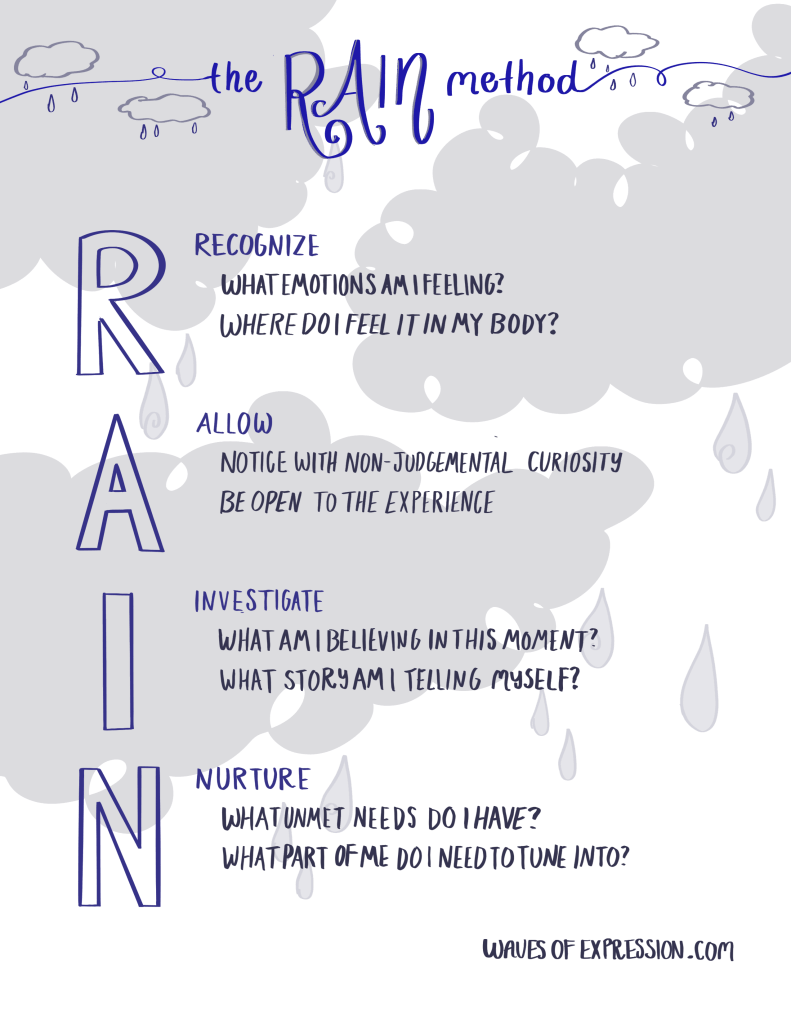
RAIN is an acronym that stands for:
- R – Recognize
- A – Allow
- I – Investigate
- N – Nurture
Let’s walk through each step, how it works, and how you might use it in your own life.
R – Recognize

Ask yourself: “What emotions am I feeling right now? Where do I feel them in my body?”
For example, you might realize:
- “I’m feeling anxious. My chest feels tight and my stomach feels unsettled.”
- “I’m feeling sad. My throat feels heavy and there are tears behind my eyes.”
This step is about slowing down enough to name what is happening inside of you.
A – Allow

Once you’ve recognized what’s going on, the natural instinct may be to push it away or judge yourself for feeling it. Instead, Allow asks you to soften and say:
“This is here. It’s okay that it’s here.”
Think of this step as giving your emotions a chair to sit in, without trying to push them out of the room. You might say:
“I’m letting my sadness be here for a moment without fixing it.”
“I’m noticing my anxiety without judgment.”
I – Investigate

This step helps us move a little deeper: “What am I believing in this moment? What story am I telling myself?”
Often our emotions carry an unspoken narrative:
- “If I fail at this project, it means I’m not good enough.”
- “If people see me sad, they won’t want to be around me.”
By investigating, you are not trying to criticize yourself, but rather to shine a light on the deeper beliefs fueling your feelings.
N – Nurture

Finally, ask: “What unmet needs do I have? What part of me needs care right now?”
This might sound like:
- “I need to remind myself I am safe.”
- “I need to take a break and rest.”
- “I need compassion for the little part of me that feels scared.”
Nurturing can take many forms: placing a hand on your heart, breathing deeply, speaking affirmations, or simply giving yourself permission to rest.
When to Use RAIN
RAIN is especially helpful in moments of:
- Feeling emotionally overwhelmed
- Facing anxiety, fear, or sadness
- Noticing self-critical thoughts
- Times when you’re “reacting” rather than “responding”
It’s not about fixing the problem immediately, but about pausing to relate to yourself with kindness. By practicing RAIN, you create space between your emotions and your reactions, which leads to greater self-awareness and peace.
Why It’s Beneficial
- Emotional regulation: RAIN helps your nervous system move from overwhelm into balance.
- Self-compassion: It invites you to care for yourself the way you’d care for a close friend.
- Clarity: By investigating and nurturing, you can uncover the deeper needs underneath your emotions.
- Resilience: Practicing RAIN builds the inner habit of responding gently, even in tough moments.
Reflection Questions:
- What emotions have I been ignoring lately that might need to be recognized?
- When I allow myself to feel, what changes in my body?
- What story do I often tell myself when I’m stressed?
- What is one nurturing practice I can offer myself this week?
- How might RAIN help me move from reacting to responding?
Reflect Through Art:
Since emotions can sometimes be difficult to put into words, art can be a powerful companion to the RAIN method. Here are three projects to help you process:
- Emotion Map Collage
- Using magazines, photos, or colored paper, create a collage that represents where you feel emotions in your body. Label or color-code different areas.
- The Story Behind the Storm
- On one half of a page, draw or paint the emotion you’re feeling (the storm). On the other half, illustrate the story or belief fueling it (the “why”). Then add a final layer—what nurturing response might bring balance (like a sun breaking through).
- Affirmation Art
- After moving through RAIN, choose one nurturing phrase or affirmation (ex: “I am safe,” “I am enough”). Create a mixed-media art piece that embodies that affirmation—paint, write, or collage the words in a way that you can return to when you need it.
REMINDER: the RAIN method is not about erasing difficult emotions, but about meeting yourself with gentleness and curiosity. With practice, it becomes less about weathering a storm alone and more about discovering you can hold the umbrella for yourself.





 WAVES OF EXPRESSION
What did you think of this idea??