Have you ever felt the tension between who you are and who you want to be?
That quiet ache between your current reality and your highest vision?
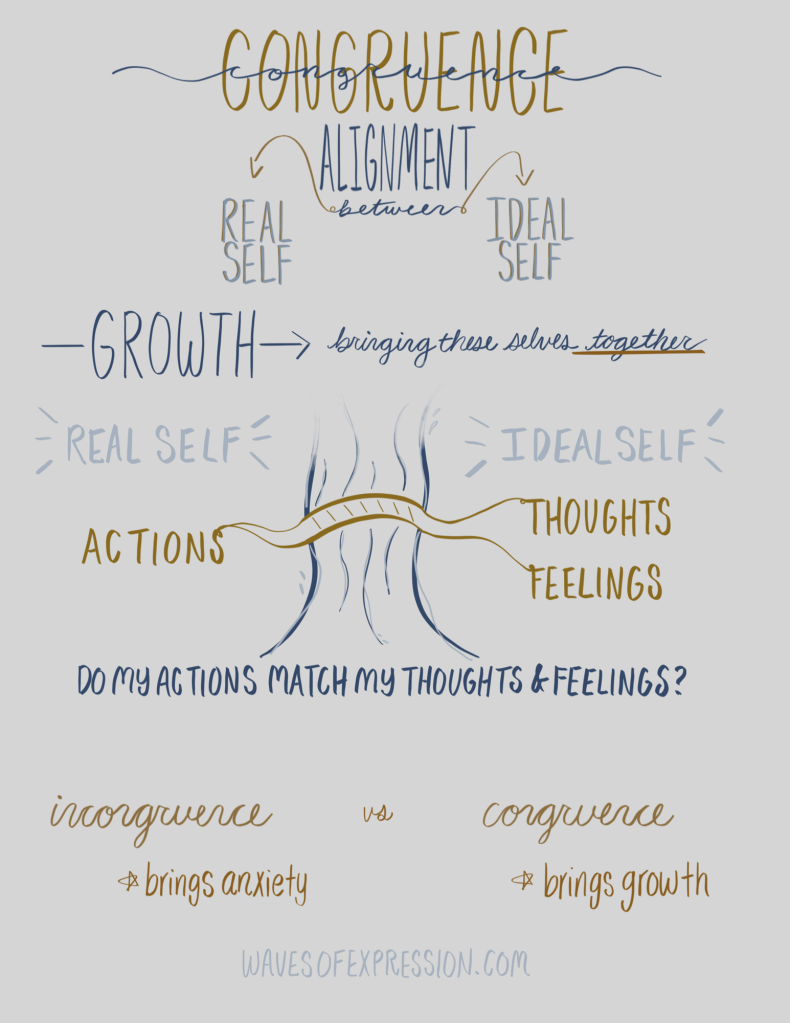
That space is called incongruence—the gap between the real self (how we see and behave right now) and the ideal self (the person we aspire to become).

When we live too long in that gap, we feel anxiety, frustration, or self-doubt. But when our thoughts, feelings, and actions begin to align, we experience congruence—a state of inner peace and authenticity where we can finally exhale and say, “This is me.”
What Is Congruence?
In psychology, congruence means harmony between our inner world and outer expression.
It’s when our real self and ideal self move closer together, forming a bridge of integrity and authenticity.
Carl Rogers, a pioneer in humanistic psychology, described congruence as living in alignment with one’s true feelings and values—where the self becomes a unified whole instead of fragmented parts.
When our actions (real self) reflect our intentions and values (ideal self), we experience a deep sense of peace and flow.
But when those two selves drift apart—when we act out of fear, obligation, or self-doubt—we experience incongruence, which often shows up as:
- Inner conflict or anxiety
- Self-criticism and confusion
- Feeling disconnected from meaning or purpose
Growth, then, isn’t about becoming someone different.
It’s about bringing who you already are into alignment with who you’re meant to be.
Bridging the Real and Ideal Self
Think of congruence as a bridge.
On one side is your real self—your current emotions, habits, and limitations.
On the other is your ideal self—your intentions, dreams, and higher awareness.
Each conscious choice you make—each moment of honesty, compassion, or faith—is a plank laid across that bridge.

Growth happens not in perfection, but in the building your bridge one piece of wood at a time.
The more your daily actions reflect your deeper truth, the stronger that bridge becomes.
Soon, the distance between your real and ideal self narrows—and your inner world feels steady, grounded, whole.
The Role of Spirituality in Alignment
Spirituality offers a pathway toward congruence.
It reminds us that we are already connected to something larger—God’s presence and/or universal love.
When we approach self-alignment spiritually, we stop trying to “fix” ourselves and instead learn to listen.
We begin to trust that our ideal self isn’t a fantasy—it’s the whisper of our soul calling us home.

Practices like prayer, meditation, and mindful art can help us attune to that guidance.
In spiritual congruence, we act not just from ego or ambition, but from alignment with truth, compassion, and purpose.
Creative Reflection: Art & Journaling Prompts
Integrating art and journaling into your spiritual growth practice helps translate insight into embodiment. Try these short, gentle prompts:
Journaling Prompt:
“Where do I feel most aligned between who I am and who I want to be? Where do I feel tension or disconnect?”
Write freely for 10 minutes, without judgment. Notice patterns or emotions that surface.

Art Prompt: “Bridge Between Selves”
- On one side of a page, sketch or paint symbols of your real self—the present version of you.
- On the other side, depict your ideal self—qualities, emotions, and imagery that represent your highest growth.
- Between them, draw or collage a bridge—patterns, colors, or shapes that represent the actions or spiritual practices that help you align.
As you create, reflect on the truth that the bridge is already forming—every time you choose honesty, presence, or love.





 WAVES OF EXPRESSION
What did you think of this idea??