Have you ever felt your heart race before your mind could even name why? Or noticed tears welling up long before you could form words for what you were feeling? Our bodies often know our emotions before we do.

Learning to identify emotions through the sensations in our body is a powerful tool for awareness, healing, and emotional regulation. It’s part mindfulness, part compassion—and it begins by tuning in to the quiet language our body speaks every day.
The Body Speaks Before the Mind Understands
Emotions are full-body experiences. They’re not just thoughts or moods — they are chemical and physiological responses to our internal or external world. Each emotion has its own “signature” in the body, a pattern of sensations that can teach us what we’re truly experiencing beneath the surface.
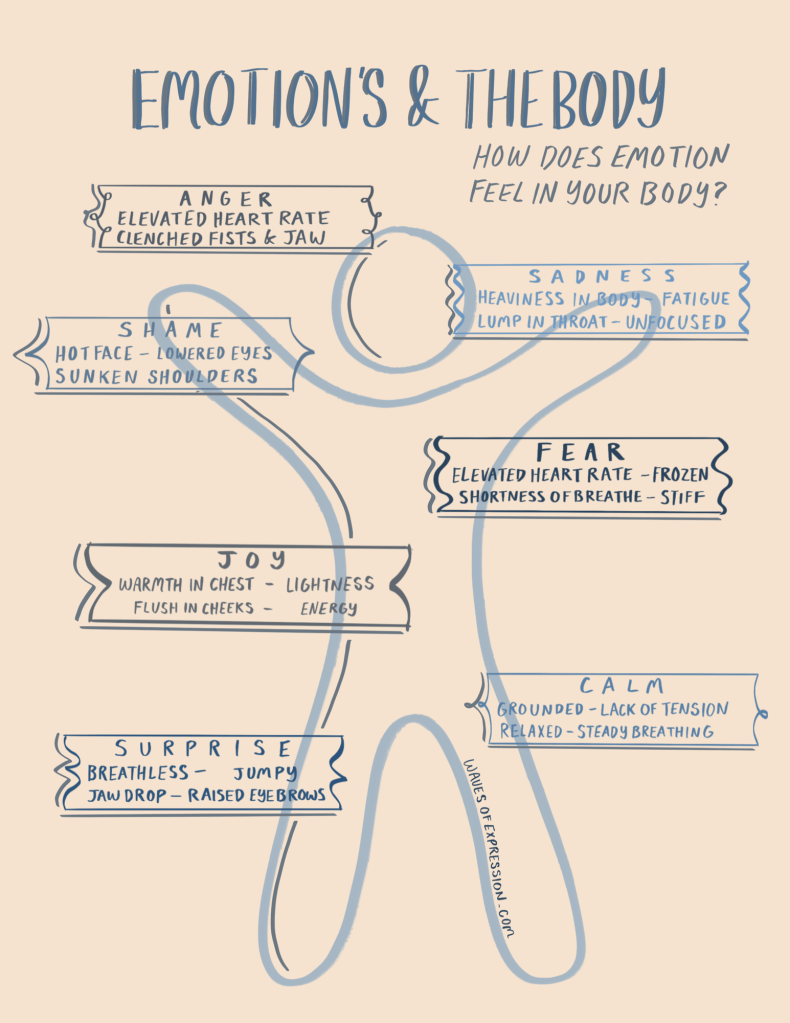
Here are a few examples of how emotions might show up physically:
- Anger — elevated heart rate, clenched fists or jaw, flushed face, tension across the shoulders.
- Sadness — heaviness in the chest or limbs, fatigue, lump in the throat, watery eyes, difficulty focusing.
- Shame — heat rising to the face, lowered eyes, collapsed posture, rounded shoulders, desire to shrink.
- Fear — racing heart, shallow breath, frozen or stiff muscles, tight chest, alertness or scanning.
- Joy — warmth in the chest, energy through the limbs, lightness, a spontaneous smile, steady yet open breathing.
- Calm — grounded feet, steady breath, relaxed muscles, a quiet mind, sense of safety.
- Surprise — breathless or jumpy sensation, widened eyes, raised eyebrows, jaw drop, energy burst.
When we notice where an emotion lives in our body, we gain the power to pause and respond rather than react.
Guided Meditation: Checking In With Your Body

Take a moment to find a comfortable position.
Let your eyes soften or close, and take a slow, deep breath.
Notice your feet on the floor — the solid surface supporting you.
Now, bring your attention up through your body:
- Notice any tension or tightness.
- Where is your body holding energy?
- Where does it feel heavy, warm, or cold?
Without judgment, name what you find. Maybe your jaw is tight — could that be frustration? Maybe your chest feels heavy — is there sadness there?
You don’t need to fix anything. Just listen. This simple act of noticing is the first step to emotional awareness.
The Two-Way Street: Body and Emotion
What’s fascinating is that this communication goes both ways.
Just as emotions can create sensations in the body, we can use the body to calm our emotions.

When our nervous system senses safety, our emotions often soften and settle. Here are a few grounding techniques to try when emotions start to feel overwhelming:
- Notice the ground beneath you. Feel your feet pressing into the floor. Let that remind you that you are here, safe, and supported.
- Release physical tension. Unclench your fists. Roll your shoulders back. Relax your jaw.
- Focus on breathing. Try breathing in for four counts, hold for one, and exhale for six. Feel your breath lengthen and slow down.
- Name what’s happening. Say quietly to yourself, “This is my body feeling fear,” or “This is my body holding sadness.” Naming helps the mind and body integrate the experience.
- Engage your senses. What can you see, smell, or feel right now that is neutral or comforting? This anchors you back into the present moment.
The more often we practice, the easier it becomes to recognize when an emotion is stirring before it overwhelms us.
Guided Meditation: Releasing and Resetting
If you’d like, take another minute to practice softening the body now.
Inhale deeply through your nose, feeling your ribs expand.
Exhale slowly through your mouth, letting your shoulders drop.
Notice if any part of you feels tight — maybe your stomach, your jaw, your throat.
With each breath, imagine sending kindness there.
You might quietly say, “It’s okay to relax. It’s okay to feel.”
Continue until you sense even the smallest shift — a tiny moment of ease or space.
That moment of ease is your nervous system remembering safety.
Why This Practice Matters
Identifying emotions in the body isn’t just about naming sensations — it’s about reclaiming the connection between mind, body, and spirit.
When we honor what our body tells us, we move closer to authenticity, presence, and healing.
The next time you feel overwhelmed, pause and ask:
What is my body saying right now?
Start anywhere — with your thoughts, your sensations, your actions, or your emotions — and gently build from there. Over time, you’ll find that listening to your body doesn’t just help you process emotions; it helps you live more fully within your own skin.

Painting Project: “Emotion Meets the Body”
- Begin by lightly sketching a simple outline of a body — it could be abstract or symbolic (e.g., just a silhouette).
- Using your chosen colors, paint areas of the body to represent where different emotions live:
- Warm colors (red, orange, yellow) for activation — anger, fear, excitement
- Cool colors (blue, green, violet) for calming — sadness, peace, reflection
- Layer your paint intuitively, noticing how colors mix and overlap. Let the water or brushstrokes mirror the movement of your emotions.
- When finished, take a moment to notice your breath — has it shifted since you began?
Reflection
- What areas of your body felt most alive as you painted?
- Did any emotions surprise you by where they showed up?
- If this painting could speak, what message might it have for you?







 WAVES OF EXPRESSION
What did you think of this idea??